News
March 30, 2026
A Montreal Solution to Prevent Japan’s Housing Crisis
How Maket Technologies is accelerating and optimizing residential design through generative AI.
In Japan, where land is scarce and the warning signs of a housing crisis are mounting, a Quebec-made solution has been chosen to tackle the challenge. Maket Technologies, a Montreal startup that has been accelerating within the IVADO research ecosystem since 2022, has signed a strategic partnership with Lib Work, one of Japan’s largest residential builders. The commercial agreement aims to deploy the first AI-driven automated design system optimized for the Japanese market, cutting timelines, costs, and reliance on individual designers’ expertise.
Who is Maket? A virtual architect for everyone.
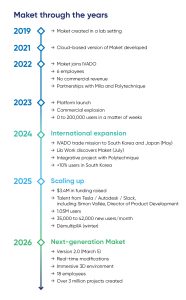
Maket is an architectural design software platform powered by generative artificial intelligence. It generates complete architectural plans, renders them in 3D, and automatically adapts designs to the constraints of a given lot, regulatory framework, and budget. Founded in 2019 by Patrick Murphy and Stéphane Turbide, the company is now led by three people: Murphy and Turbide, as CEO and COO respectively, and Simon Vallée heading product development.
“We’re a bit like the ‘Canva’ of architecture,” says the COO. “Someone with no architectural background, no technical knowledge, can now design and explore a floor plan.”
Now available in beta, the platform’s straightforward interface allows users to modify plans in real time within an immersive 3D environment, “a bit like the video game The Sims.” Users can explore endless design variations and instantly visualize the impact of any change.
The Japanese partnership: a challenge turned opportunity
For Lib Work, partnering with Maket had become a necessity. Japan’s residential construction industry faces three compounding challenges: a growing dependency on individual architects’ expertise, labour shortages, and rising construction costs. With a stable population, intense urbanization, and a chronic lack of space, Japan must optimize every square metre.
What tipped the scales in Maket’s favour? The robustness of its algorithms, developed with the support of Quebec’s research ecosystem since the company joined IVADO in 2022.
From the outset of that relationship, Maket was able to draw on IVADO’s resources to develop its design algorithms. The company participated in integrative projects with Polytechnique Montréal focused on spatial optimization, took part in the DémultiplIA program, and gained access to the expertise of students from affiliated research centres. In total, five students and interns contributed to the company’s technological development through IVADO’s Scientists-in-Residence and Scientists-in-Action programs.
“What made all the difference was being able to bring scientists in to work on powerful algorithms. It allowed us to limit our technological risk and get to a marketable solution much faster,” says Turbide.
“Japanese builders weren’t just looking for a design platform, they wanted robust algorithms capable of adapting to their unique regulatory and spatial constraints. What drew us to Maket is precisely that ability to solve complex urban challenges through AI. This is exactly the kind of innovation we aim to propel: Montreal-made solutions that address global needs,” says Nancy Laramée, Director of Partnerships at IVADO.
In May 2024, Maket took part in a trade mission to Asia organized by IVADO, presenting its technology in South Korea, including at the Seoul Hub. From there, the company continued on to Japan, where it was received by Quebec’s Delegate in Tokyo. It was during that visit that Lib Work first encountered Maket.
Maket made five trips to Japan, held biweekly meetings with Lib Work, and delivered a paid proof of concept between 2024 and 2026. Support from the National Research Council of Canada and Quebec’s trade delegates proved instrumental in establishing the startup’s credibility with its Japanese partners.
What about Canada?
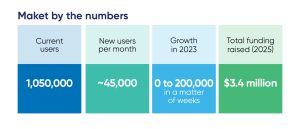
Maket now counts 1,050,000 users across 22 countries. Stéphane Turbide believes Canada could certainly benefit from the solution, particularly to streamline the rapid adaptation of plans to regulatory and site-specific constraints. A widespread approach in Canada involves offering pre-designed home models that builders then adapt to each lot. But the reality on the ground is rarely that straightforward. That is precisely where generative design comes in: adapting plans in real time as constraints evolve.
“When a city requests a change to a project, that change has to go back through the architect, then the contractor, then the client. That’s a minimum of three weeks per cycle. Every minor change restarts the revision cycle. So you’re looking at five to eight months of approvals for a single project,” he explains.
With municipal regulations integrated directly into the platform, Maket can rapidly adapt plans and ease the permitting process. Real-time design enables instant adjustments based on regulatory requirements, lot parameters, and requested changes, eliminating the delays and costs associated with the administrative back-and-forth. Since its commercial launch in July 2023, the platform has facilitated the creation of more than three million architectural projects.
For Maket, the Japanese partnership opens the door to a longer-term objective: automating geographic contextualization so that a user in South America, Africa, or Europe can generate a plan adapted to local constraints in just a few clicks. A prospect that could fundamentally reimagine access to residential architecture at a global scale.