
News
August 26, 2026
Transparent AI to verify information
Now publicly available, the AI tool Veracity, developed by the team of IVADO researcher Jean-François Godbout, assesses the reliability of a claim by exposing its sources and reasoning. The Canadian Senate has added it to its internal resources.
A headline, an excerpt, or a claim is enough. The user submits the content to Veracity, which assesses its reliability, explains its analysis in plain language, and presents the sources consulted.
This transparency sets the tool apart from several artificial intelligence systems that deliver an answer without always making clear how they arrived at it. Designed by a team co-led by Jean-François Godbout, professor in the Department of Political Science at Université de Montréal, Veracity aims to support fact-checking rather than ask users to simply trust it.
Developed as part of the work of IVADO’s Research Cluster on Implementation Science and Responsible Governance, the tool has already gained a first measure of institutional recognition. In May 2026, the Canadian Senate added it to the resources made available to senators and their staff to assess the reliability of claims brought to their attention.
A tool that shows its work
When content is submitted to it, Veracity first queries its model’s parametric memory, meaning the knowledge acquired during training. It then consults external sources, to which it assigns weight according to their credibility. Major media outlets and news agencies, for example, receive a higher rating than a little-known website.
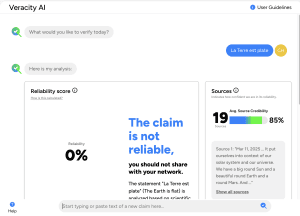
At the end of this process, the tool produces a score from 0% to 100%, an explanation, and the list of sources consulted.
Veracity avoids, however, declaring a claim to be “completely false.” Instead, it indicates that the information could not be verified, that the available sources are unreliable, or that the claim is probably inaccurate.
“We really wanted to calibrate the language so it wouldn’t come across as too heavy-handed, because we want to encourage people to go verify the information themselves,” explains Jean-François Godbout, also an IVADO researcher.
This caution is an integral part of the approach taken. “When you ask Claude or ChatGPT to fact-check something, you don’t really know which sources were consulted,” the professor points out. With Veracity, the sources are displayed, their degree of credibility is explained, and the assessment is justified. Users can therefore examine for themselves the elements the result is based on.
This choice also draws on Jean-François Godbout’s own research, which suggests language models can help correct mistaken beliefs by maintaining a patient, factual tone. “If you’re talking with a friend, that person can get worked up,” he illustrates. The model, by contrast, can present facts coherently without losing its composure.
Presented by its creators as an open-source system, Veracity can also serve as a starting point for other teams looking to build similar tools for different electoral or linguistic contexts.
A transparency with limits of its own
The team does not claim to have eliminated every blind spot. Veracity runs on Llama 3.3, a language model developed by Meta. The researchers did not create it. They adapted and guided it using a set of instructions on how to assess sources and claims.
“We don’t have control over the model itself because it’s an American model,” acknowledges Jean-François Godbout.
During one demonstration, Reddit turned up among the sources consulted, which surprised the researcher himself. During a demonstration in French, Wikipedia ended up topping the list of most credible sources consulted. A choice the researcher himself considers of little relevance for this type of claim.
The limits of French-language coverage became clearer when the same test, repeated in English, surfaced sources absent from the French version.
He sees this as a structural limitation rather than a functioning problem.
Results can also vary slightly when the same claim is submitted more than once. The tool also struggles with questions that require precise temporal context when none is provided.
The credibility rating assigned to sources also remains fixed and is based on earlier research. The team is working to make it dynamic, so that it can evolve based on published content and the networks of links between sites.
These limits feed the researchers’ desire to gradually reduce their dependence on an American model they don’t control. They also show why Veracity presents its analysis as an assessment to be examined rather than a final verdict.
Quebec is not immune
The work carried out by Jean-François Godbout and his team calls into question the idea that Quebec’s distinct linguistic and cultural character offers it some measure of protection against misinformation.
As part of her master’s degree in political science at UdeM, Camille Thibault analyzed, under his supervision, a large corpus of political messages posted on Twitter. The results indicate that misinformation is also a significant issue in Quebec.
| Indicator | Value |
| Messages analyzed (complete corpus) | 2,000,000+ |
| Users concerned | ~274,000 |
| Manually annotated posts | 3,051 |
| False messages detected (total) | 640,000 |
| Proportion of misinformation in political messages | 31.8% |
| False messages per day | 3,000 to 25,000 |
| Daily proportion of political posts | 25% to 39% |
Source: research by Camille Thibault, under the supervision of Jean-François Godbout, Université de Montréal, master’s degree in political science — Quebec provincial election campaign, 2022.
Jean-François Godbout remains cautious about their scope. “That false content was published doesn’t mean it was widely seen, let alone that it changed a single voter’s behaviour,” he cautions.
This research nonetheless provides data that can inform initiatives aimed at protecting democratic debate. The Act to amend the Election Act primarily to preserve the integrity of the electoral process, assented to in Quebec on May 30, 2025, notably creates an offence related to the knowing dissemination of false information with the intent to influence an election or disrupt its conduct.
A first institutional recognition
Veracity’s addition to the Canadian Senate’s internal resources followed a presentation by Jean-François Godbout to the Canadian Study of Parliament Group in April. The Senate’s Office of the Law Clerk and Parliamentary Counsel subsequently adopted the tool to help parliamentarians and their staff examine certain claims.
This recognition does not dispel the researcher’s concerns. What he fears is not just the circulation of inaccurate information, but the gradual erosion of trust in information and, in the longer term, in institutions.
“If we move into an environment where we’re never sure of the quality of information, that will affect the resilience of our democratic institutions,” warns Jean-François Godbout.
Veracity does not claim to solve this problem on its own. It offers, instead, a way of tackling it, one verification at a time, by making its process visible.
